Do not hire a contractor in NC until you verify they have the licensing, proper permitting, and insurance at a minimum.
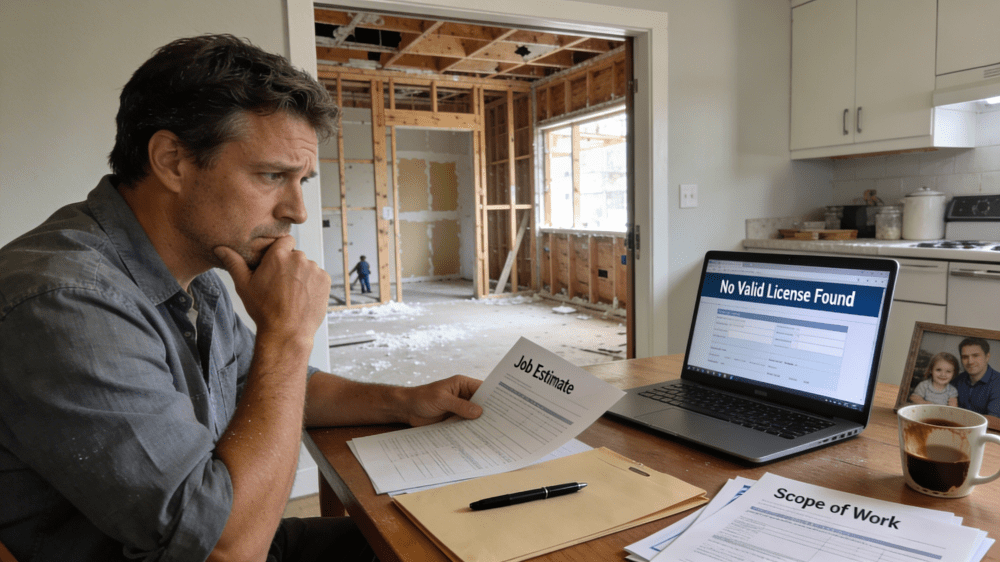
Hiring a contractor can feel like progress. You finally have a bid. The numbers look workable. The contractor sounds confident. Maybe they even say they can start right away.
This is the moment many homeowners relax. However, it is also the moment many homeowners get into trouble.
Before you sign anything or hand over money, verify three things for yourself: the contractor’s license, insurance, and complaint history. Do not assume. Do not take their word for it. Do not let a low bid or a fast start date rush you past this step.
In North Carolina, this matters more than many homeowners realize. The wrong hire can leave you with permit problems, uninsured damage, abandoned work, or almost no practical recourse if the job goes south. Let’s take a look at the minimum things every property owner should do before they hire a contractor in NC
Why the Lowest Bid Can Cost You the Most
A low bid gets attention.
Homeowners want to be careful with money. They want value. They do not want to overpay. All of this makes sense.
But the cheapest number is not always the lowest cost. Sometimes it is just the least complete number. Sometimes it hides missing scope, no permit planning, weak insurance, or no proper licensing at all.
In North Carolina, a general contractor license is required for projects where the cost of the undertaking is $40,000 or more. That threshold matters because it is not just about labor. It includes labor and materials together. Many remodels, additions, structural repairs, and larger renovation projects cross that line faster than homeowners expect.
So if one contractor comes in far below the others, ask better questions. Are they licensed for that size project? Are they carrying proper insurance? Are they pricing the same scope? Or are they just saying what they need to say to get the job?
When you hire a “contractor” who is not licensed and/or does not pull permits, it is you, the property owner, who assumes the responsibility.
Why “We Can Start Next Week” Is Often a Red Flag
Homeowners usually hear that and think they got lucky.
If a contractor says they can start next week on a project that clearly involves structural work, HVAC, electrical, plumbing, or a total cost over $40,000, that should make you slow down and look harder.
Why?
Because a project involving this type of work involves more than labor availability. It requires planning, permit review, trade coordination, and in many cases licensed subcontractors or a properly licensed general contractor. If someone is ready to jump in immediately on a job that obviously needs permits, it is often a sign they do not plan to pull them, do not understand the process, or are willing to work outside it.
That is not speed. That is risk.
A legitimate contractor may have an opening in the schedule. However, they still should be talking about scope, drawings, trade coordination, permit requirements, and what has to happen before work starts. If that conversation is missing, pay attention.
What Homeowners Usually Assume
Most homeowners assume a person would not be operating as a contractor unless they were legitimate.They might include on their business card or website that they are “licensed and insured”. However, the burden falls on you to verify this information.
A contractor may sound experienced, glowing reviews and even references. They may show you photos. They may have a polished website. They may even hand you a license number. None of that proves the license is active, current, or tied to the company standing in your home.
A lot of homeowners also assume a pulled permit means everything checked out. You still need to know whose name is on the permit, whose license is tied to it, and who is actually responsible for the work.
What North Carolina Law Actually Requires
North Carolina has contractor licensing rules for a reason. They exist to protect the public. On projects over the legal threshold, a general contractor must hold the proper state license.
A license is not just a formality. It is part of the legal structure that helps establish who is qualified to take on the job, what level of work they can perform, and what recourse may exist if something goes wrong.
A contractor may have a license, but the limitation still has to fit the size of your job. If the project value exceeds what their license allows, it is still a problem.
This is one reason homeowners need to stop treating licensing like a box to check. It is part of the basic risk review for the whole project.
Why Insurance Protects More Than the Contractor
A license is only part of the picture. Insurance matters just as much.
You want proof of general liability coverage. You also want proof of workers’ compensation coverage when it applies. If something gets damaged or someone gets hurt, missing or lapsed coverage can pull the homeowner into a problem they never expected.
Do not assume it is in place. Ask for current certificates. Read them. Make sure the business name matches the contract. Make sure the effective dates are current. If something feels off, stop there to protect your home, money and peace of mind.
Why Complaint History Tells You What the Bid Never Will
Perfection is not the standard for general contractors.
The real question is whether there is a pattern of trouble. Missed jobs. Deposit issues. Abandoned work. Poor communication. Repeat complaints. Misrepresentation. Unfinished punch lists. Excuses that never end.
Reviews are only part of the story. Look wider than that. Search the business name. Search the owner’s name. Look for complaints, disputes, lawsuits, or repeated warning signs that point to the same kind of problem over and over.
One complaint may not mean much, but a pattern means something.
Why This Matters Even More in Coastal North Carolina
In Dare County and parts of Currituck County, homeowners often hire from a distance, move quickly when a contractor says they have an opening, or lean too hard on a referral without doing the basic checks.
Some operators call themselves remodelers, handymen, or project managers to blur the issue. Some act as though licensing rules do not apply to them. Others make it sound normal to work under someone else’s license or “figure out permits later.”
Larger remodeling and addition projects carry real financial risk. Real safety risk too. In a coastal market, you can also be dealing with floodplain review, structural requirements, septic coordination, or local zoning review depending on the property and the scope. With so much complexity, it is even more important to verify who is actually qualified to lead the job.
What Permitting Usually Looks Like
Permit timing depends on the type of project and where the property is located. A smaller interior job may move faster. A project involving structural work, electrical, plumbing, HVAC, flood-zone review, septic review, or zoning questions usually takes more time.
In Dare County and its towns, in Currituck County, in Camden County, and in Pasquotank County, the review path can vary based on location, scope, and whether the application is complete. A straightforward permit may move through faster. A more involved project can take longer. It usually takes days or even weeks depending on the volume of permits and type of work. If plans are incomplete or the property raises extra review questions, it often takes even longer.
So when someone says they can start right away on a major project, the better question is not “How soon can you show up?”, it is what has to happen before you can start legally.
How to Verify That Permits Were Actually Pulled
Do not assume permits were pulled just because someone says they are “handling it.”
Verify it.
Ask for:
- The permit number.
- A copy of the issued permit.
- The name listed on the permit.
- The contractor tied to the permit.
- The inspection record once work begins.
Then check it yourself.
If your local building department has an online search portal, use it. If it does not, call the inspections or permitting office directly and ask whether a permit has been issued for your address, what type of permit it is, and whose name is attached to it.
The name on the permit should match the contractor you hired or the licensed party truly responsible for the work. If the permit is under another company’s name and no one can clearly explain why, it is another red flag.
Homeowners should also watch for common warning signs:
- “We do not need a permit for that.”
- “We can start now and deal with permits later.”
- “I use another guy’s license.”
- “The permit is in process,” but they cannot provide a number.
- “It’s faster if we just keep this small on paper.”
None of that protects you.
How to Verify a Contractor Before You Sign Anything
This part is simple.Do these steps every time:
- Get the contractor’s full legal business name and license number.
- Verify that license independently.
- Confirm it is active and fits your project size.
- Ask for current insurance certificates.
- Make sure the insurance name matches the contract name.
- Search for complaints, disputes, and repeated warning signs.
- Confirm who is pulling permits and whose name will be on them.
- Do not sign until those pieces line up.
This process does not take long, and it protects you from one of the most common homeowner mistakes… trusting the appearance of legitimacy instead of verifying actual legitimacy.
The Mistakes That Create Expensive Regret when you hire a contractor in nc
The biggest mistake is trusting the contractor’s word regarding proper licensing and permitting. Letting price override judgment can have major consequences for homeowners.
Homeowners also get into trouble when they think a referral is enough by itself. Referrals help, but they are not verification. Another common mistake is confusing speed with professionalism. A fast promise can sound reassuring. On a serious project, it can mean the exact opposite.
Another mistake is assuming licensing only matters on large homes or projects. It matters on remodeling and home addition work once the project crosses the legal threshold, and many projects cross that line faster than homeowners expect.
The lowest bid can be so misleading. If one number comes in far below the others, the question is not just whether it is a good deal. The question is what is missing.
How to Protect Yourself Before the Contract Does the Opposite
You do not need to become an expert in contractor law, you just need to slow down long enough to verify what matters.
If a contractor hesitates when you ask for a license number, current insurance, complaint history, or permit details, pay attention. If the name on the estimate does not match the license, pay attention. If the price seems too good to be true and the paperwork feels vague, pay attention.
Taking these basic steps is how you avoid turning a low bid into a very expensive lesson.\
Let Island Contractors Manage Your Project
If you are planning a remodel or addition in Dare County, Currituck County, Camden County, or the Elizabeth City area and want a smarter planning conversation before you sign with anyone, submit a project inquiry. Before you hire a contractor in NC, we are happy to talk through what proper vetting looks like, what to watch for, and how to protect yourself before the contract does the opposite as your construction consultant or manager.