
Change orders and delays are almost inevitable in a major remodel or addition project.
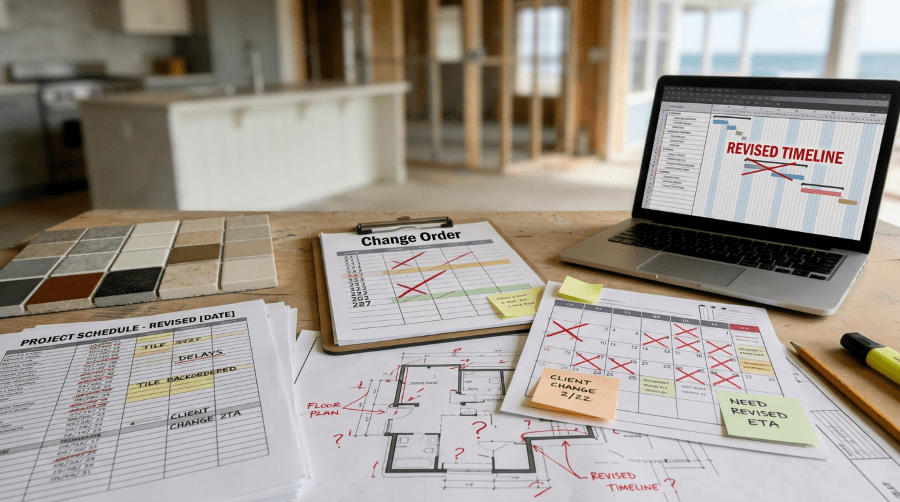
Most homeowners do not start a remodel or addition expecting to create delays. They are trying to make good decisions. They want the project to come out right. They want to avoid regret. That is reasonable.
However, homeowner indecision and change orders really do contribute to delays and cost overruns.
In places like Dare, Currituck, Camden, and the Elizabeth City area, some changes come from real discovery. Rotten framing. Hidden water damage. Site issues that were not fully visible at the start. Other changes come from rushed planning, evolving preferences, or decisions that should have been made before work began.
That distinction matters.
Why Changing Your Mind Costs More Than Most People Expect
A lot of homeowners think a change just means paying the difference between one choice and another.
When you change a decision after work starts, you may be paying to remove completed work, reorder materials, restage labor, and reshuffle trades that were already scheduled in sequence. That one decision can affect several parts of the project at once.
There is also a cost people do not always see right away. Momentum. Construction runs best when work moves in order. One trade finishes. The next starts. Then the next. When that rhythm breaks, the schedule gets harder to recover.
That is why a “small” change can create a bigger problem than expected. Especially once framing, rough-ins, cabinetry, tile, or finish work are already in motion.
Why Indecision Creates a Different Kind of Delay
Indecision is not always the same as a change order. Sometimes nothing has to be redone. Work just stops because a required decision is still hanging out there.
That happens a lot with finish selections like tile, flooring, plumbing fixtures, lighting and paint colors. Homeowners often see those as late-stage choices. In reality, many of those items carry lead times or affect earlier work.
While homeowner indecision matters in every market, in coastal areas, where scheduling trades and materials already takes more coordination, it can delay schedules significantly . In Dare County or Currituck County, one missed selection deadline can push the schedule farther than people think.
You are not trying to be difficult when you hesitate. You are trying to make the right call. However, if a decision holds up ordering or rough-in coordination, the project feels that delay.
Why Some Changes Are Necessary and Some Are Self-Inflicted
Some changes are necessary. If demolition reveals hidden damage, if an old foundation is worse than expected, or if site conditions require a different approach, that is not the same thing as changing your mind about the layout after materials are ordered. Coastal and flood-prone areas add even more variables, especially where site conditions and permitting requirements shape how work moves forward.
Those are not optional changes. They still impact cost and time, but they come from discovery.
Other changes are avoidable. Widening an island after cabinets are ordered. Moving windows after framing. Reworking a porch layout after engineering is complete. Waiting too long to choose tile or lighting fixtures. Those are not discovery issues. Those are decision issues.
That does not make you the villain. It just means the cost usually comes from the timing of the change, not from the idea itself. On the Outer Banks, these types of changes or delays often cause schedule delays.
Why Good Preconstruction Planning and Regular Communication Limits These Common Problems
This is exactly why good planning matters so much.
The more decisions you make before construction starts, the fewer expensive surprises you create once work begins. That does not mean every detail has to be perfect. It does mean the important decisions should happen in the right sequence.
Good preconstruction planning forces clarity early, which reduces change orders and delays. It helps you settle layout questions, fixture locations, cabinet details, lighting positions, finish transitions, and scope questions before the job starts moving. Once work is underway, those same questions become more expensive to answer.
With decades of experience, we have found the homeowners who slow down early usually move faster later. The ones who rush planning because they want to “get started” often end up spending more time and money fixing decisions that should have been resolved first.
Why Scope Definition is important
A lot of change-order conflict starts with vague scope.
If the drawings, selections, and specifications are not clear, then nobody is working from the same expectations. Differences between what homeowners should be included, but the contractor treats it as extra tends to cause friction and trust issues.
This is especially important on remodels and additions in places like Camden County or around Elizabeth City, where existing conditions can already create enough uncertainty on their own. If the scope is fuzzy on top of that, small questions turn into expensive disputes.
Clear planning protects both sides. It gives the homeowner a better picture of what they are agreeing to and gives the builder a cleaner path to execute the work.
Why Homeowners Freeze Up During Construction
A lot of indecision comes from fear.
Homeowners know the project costs real money. They know the decisions feel permanent. They know they have to live with the result. So they research and second-guess more. They keep one more option open “just in case.”
That is human.
However, too much hesitation usually makes the project worse, not better. A good decision made on time is often better than a slightly better decision made too late. Once the schedule gets squeezed, people tend to make rushed choices under pressure anyway.
Some decisions deserve real time. Structural changes. Layout shifts. Window placement. Major systems. Those are worth slowing down for.
Other decisions matter less than they feel like they do at the moment. Paint can change. Hardware can change. Some finish details are easier to adjust later than homeowners think.
That is why a good planning process should help you separate big decisions from small ones.
What You Can Do to Keep the Project Moving
You do not have to be perfect. Change orders and delays are part of almost every project. You do need a process.
Here are the habits that help most:
- Make decisions on the schedule provided.
- Ask early which selections drive ordering and lead times.
- Understand which decisions depend on other decisions.
- Raise changes as soon as they come to mind.
- Be honest about how you make decisions.
That last one matters more than people think.
If you know you need more time to choose, say that upfront. If you tend to make fast decisions and then rethink them later, that matters too. A good process should account for real human behavior, not some fantasy version of how homeowners “should” act.
In service areas like Dare County and Currituck County, that kind of honesty helps a lot because scheduling, permitting, and site logistics already add enough moving parts to the job.
What You Should Expect From Your Contractor
You should expect your contractor to define scope, raise questions, and explain legitimate change orders. You should also communicate about cost and schedule impact before extra work moves forward.
It is also reasonable for the contractor to expect timely decisions from you. It is reasonable for schedule extensions and cost changes to follow real change orders. It is reasonable for delayed selections to affect the timeline when ordering and trade coordination depend on them.
The goal is not to blame. The goal is shared accountability.
This approach is what keeps a project “healthy.”
Next steps to reducing change orders and Delays
If you are planning a remodel, addition, or ADU-style project, the smartest thing you can do is make decisions early and make them in the right order.
This does not mean rushing. It means getting organized before construction turns every open question into a cost issue.
Whether you are in Manteo or Moyock or anywhere in between, you want to avoid change orders, budget creep, and schedule drift, by starting with a planning conversation. Get clear on the scope, decision points, and on what needs to be settled before work starts. Equally important, homeowners should build in a contingency budget of 10-20% for potential issues discovered and decisions made after the project starts. This type of planning and budgeting helps a project stay on track … and budgets stay within your means.
If you want to talk through your project and the decisions that could affect cost and timeline, submit a project inquiry. We can start with a practical conversation about scope, sequence, and how to reduce the kinds of changes that create unnecessary stress later.